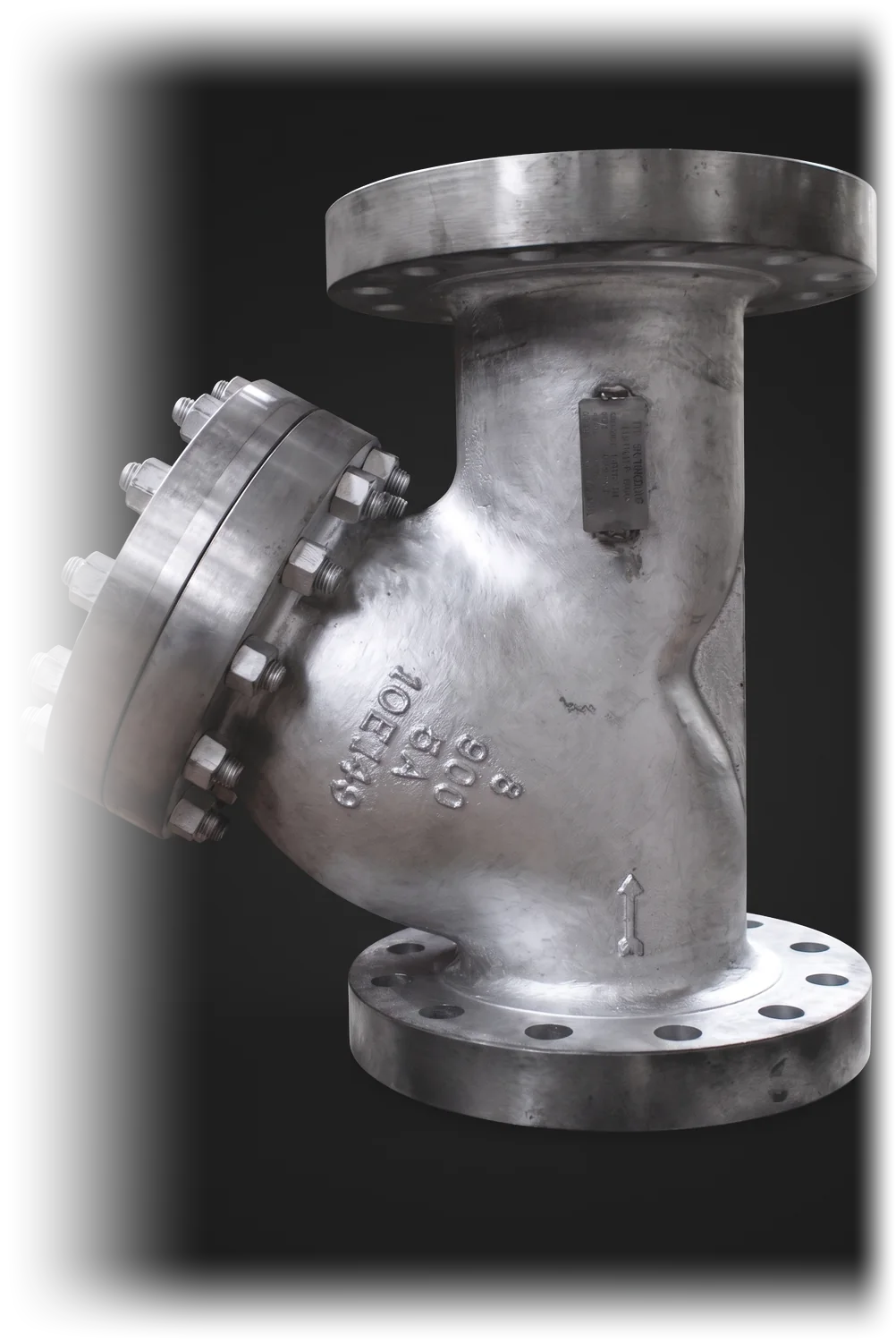
Hydrotherms
Y Strainer
Precision-engineered for pipeline protection across liquid, gas and steam services.
Size
0.5″ – 30″+
Pressure
Up to API 10,000lb
Ends
SW · BW · SCR · FLG
Precision-engineered for pipeline protection across liquid, gas and steam services.
Hydrotherms Y strainers are cost-effective solutions for the mechanical removal of unwanted solids from liquid, gas or steam lines. They protect downstream mechanical equipment such as condensers, heat exchangers, pumps, compressors, control valves, flow meters, spray nozzles, turbines and steam traps from sediment, rust, pipe scale and other extraneous debris.
Y strainers are most often installed in gaseous services such as steam, air, nitrogen and natural gas, and are also used for liquids. For applications with heavier dirt loading, a Y strainer can be fitted with a blow-off connection that permits the screen to be cleaned without removing it from the strainer body.
Consult Hydrotherms for other end connections and standards.
Material certification to EN 10204, with NACE MR0175 / ISO 15156 compliance for sour service, and a full suite of additional testing available on request.
| Certification | Service Condition |
|---|---|
| Standard service | |
Supplied as standard on all Hydrotherms strainers. Certifies that pressure-wetted components meet the specified material standard, validated by the manufacturer's authorised inspection representative independent of the manufacturing department. | |
| Critical service | |
For applications demanding the highest level of assurance, certification is countersigned by an independent third-party inspector or the customer's authorised representative, providing an additional layer of verification. | |
| Sour service — H₂S present | |
Where hydrogen sulfide is present, materials comply fully with NACE MR0175 / ISO 15156 — governing hardness limits, heat treatment and alloy composition across every pressure-wetted component: body, cover, screen, bolting and sealing elements. Eliminates the risk of sulphide stress cracking (SSC), hydrogen induced cracking (HIC) and SOHIC. | |
| Sour · critical · offshore | |
The most demanding sour-service specification: independent third-party verification combined with full NACE compliance, for offshore, regulated upstream oil & gas, sour gas processing, amine treating and LNG applications. | |
Beyond the standard hydrostatic test, Hydrotherms can perform the following examinations and supply the corresponding certificates on request. Select a test to read its scope.
Every Hydrotherms strainer is hydrostatically tested to 1.5 times the maximum allowable working pressure (MAWP) prior to despatch, in accordance with ASME Section VIII requirements. Shell integrity, joint tightness, and cover seal performance are verified under sustained test pressure. A formal hydrostatic test certificate — recording test medium, test pressure, hold duration, and witnessed result — is issued as a standard deliverable with every order, with no exceptions.
Performed using compressed air or inert gas (typically nitrogen) in lieu of hydrostatic testing, where water contact is undesirable or impractical. Used to verify pressure integrity and leak-tightness. Conducted at agreed test pressures per applicable code requirements, with all safety precautions for pneumatic testing in place.
Measures the differential pressure loss across the strainer at specified flow rates and fluid conditions. Results confirm that the strainer meets the pressure drop requirements of the system design and provides a baseline for future fouling monitoring in service.
The most sensitive leak detection method available. Helium is used as a tracer gas and detected by a mass spectrometer leak detector, capable of identifying leakage rates as low as 1×10⁻⁹ mbar·l/s. Specified for critical applications including cryogenic, toxic fluid, high-vacuum, and semiconductor services.
The strainer is pressurised to destruction to determine its actual burst pressure and failure mode. Confirms that the design safety margin exceeds the minimum required factor and validates finite element analysis (FEA) predictions. Typically performed on prototype or first-article samples.
Simulates pressure surge (water hammer) conditions to verify that the strainer body, cover, and screen withstand transient peak pressure events without deformation or leakage. Critical for pump discharge and fast-acting valve installations.
X-ray or gamma-ray examination of welds and castings to detect internal discontinuities including porosity, slag inclusions, lack of fusion, and cracks — defects that are invisible to surface examination. Conducted and reported in accordance with ASME Section V and the applicable acceptance criteria of ASME Section VIII.
Detects surface and near-surface discontinuities in ferromagnetic materials by applying magnetic flux and iron particle media. Reveals cracks, laps, seams, and inclusions that could compromise the integrity of weld joints or base material. Performed to ASME Section V, Article 7.
A liquid penetrant is applied to the cleaned surface, drawn into surface-breaking defects by capillary action, and subsequently revealed by a developer. Applicable to all non-porous materials including stainless steel, duplex, and nickel alloys where magnetic particle testing is not feasible. Performed to ASME Section V, Article 6.
High-frequency sound waves are used to detect internal and surface flaws in welds and base material, and to measure wall thickness. Particularly effective for detecting planar defects such as lack of fusion and cracks. Also used for thickness measurement on castings and formed components where dimensional access is restricted.
A chemical surface test used to detect free iron contamination on stainless steel components. A ferroxyl reagent solution is applied to the surface; any free iron deposits turn blue, confirming the presence of contamination that could initiate corrosion in service. Mandatory for many food, pharmaceutical, and high-purity stainless steel applications.
Tensile test specimens are machined from the same heat of material as the strainer components and tested to determine yield strength, ultimate tensile strength, and elongation. Results confirm that the material meets the minimum mechanical property requirements of the specified material standard and design code.
Brinell, Rockwell, or Vickers hardness measurements are taken on base material, weld metal, and heat-affected zones. Hardness testing is mandatory for all NACE MR0175 / ISO 15156 applications to confirm that material hardness does not exceed the limits above which sulphide stress cracking can occur. Also used to verify post-weld heat treatment (PWHT) effectiveness.
Charpy V-notch impact tests are performed at the minimum design temperature (MDT) to verify that materials possess adequate notch toughness and resistance to brittle fracture. Required by ASME Section VIII for low-temperature carbon steel (LTCS) applications and for all materials used below −29°C. Results must meet the minimum absorbed energy values specified by the design code.
Electrical resistance strain gauges are bonded to the strainer body at critical stress locations. Actual surface strains are measured under defined pressure and load conditions and compared against design predictions. Used to validate FEA models and confirm structural adequacy for non-standard geometries or extreme service conditions.
A brittle lacquer coating is applied to the component surface. Under applied load, the coating cracks at yield locations, visually mapping the strain distribution and identifying stress concentration areas. Provides a full-field indication of stress patterns that complements strain-gauge point measurements.
Pressure and leak testing performed at cryogenic temperatures — typically down to −196°C for LNG and liquid nitrogen service. Confirms that all materials, welds, seals, and fasteners maintain their mechanical properties and leak-tight integrity at the extreme low temperatures encountered in LNG, cryogenic processing, and cold box applications.
Evaluates structural integrity under sudden mechanical shock loads — including those resulting from water hammer, seismic events, or transportation impacts. Required for naval, offshore, and seismically active installation sites.
Subjects the strainer to defined vibration profiles to verify that connections, fasteners, and screen elements remain secure under continuous operational vibration. Particularly relevant for strainers installed on or near rotating equipment such as pumps, compressors, and turbines.
Functional operation tests to verify that all moving components — including covers, quick-opening closures, diverter valves (duplex strainers), and access flanges — operate correctly, smoothly, and within the required torque or force limits. Confirms ease of maintenance and correct mechanical assembly prior to despatch.
Tensile or bent-beam specimens are exposed to a defined H₂S-saturated test solution at controlled stress levels to evaluate susceptibility to sulphide stress cracking (SSC) — a form of hydrogen embrittlement that affects high-strength steels in sour environments. Performed in accordance with NACE TM0177 methods. Required on critical sour service components to provide independent confirmation of SSC resistance beyond hardness compliance alone.
Plate specimens are immersed in a standard H₂S test solution per NACE TM0284 to evaluate susceptibility to hydrogen induced cracking (HIC) — step-wise cracking caused by hydrogen diffusion into the steel microstructure. Crack length ratio (CLR), crack thickness ratio (CTR), and crack sensitivity ratio (CSR) are measured and reported. Required for carbon steel pressure vessels and piping components in wet sour service per NACE MR0175 / ISO 15156.
The Hydrotherms Y strainer general catalogue — overview, size and range, materials, options, testing and certification. PDF, 8 pages. The detailed datasheet follows shortly.
DownloadInstallation orientation, blow-off connection arrangement, screen removal and cleaning procedure, and recommended maintenance intervals.
DownloadFind out how Hydrotherms Y strainers and accessories can meet your project specifications and deliver reliable performance across your operations.
Contact SalesFor all other questions — product specifications, lead times, technical documentation, or general information — please reach out and our team will respond promptly.
Contact UsA Y strainer is a mechanical filtration device used to remove solid particles — such as rust, scale and debris — from liquid, gas and steam pipelines. Named for its Y-shaped body, it protects downstream equipment including pumps, compressors, control valves, flow meters and steam traps. Hydrotherms Y strainers are available in cast and fabricated construction from 0.5″ to 30″+.
A Y strainer has a compact angled body best suited to gas, steam and clean liquid service. A basket strainer has a larger vertically-oriented chamber offering greater dirt-holding capacity and lower pressure drop, making it preferred for liquids with higher solids loading. Y strainers are typically used in smaller bore pipelines; basket strainers in larger bore liquid lines.
Up to API 10,000 lb for socket weld, butt weld and flanged end connections. Screwed end Y strainers are available up to ANSI Class 1500 lb, and fabricated Y strainers up to Class 2500 lb+ (172 BarG+). Consult Hydrotherms for your specific pressure and temperature requirements.
Yes. For any pipeline service where hydrogen sulfide (H₂S) is present, NACE MR0175 / ISO 15156 compliance is mandatory. Hydrotherms Y strainers for sour service are material-selected and manufactured to full NACE compliance — controlling hardness limits, heat treatment and alloy composition across all wetted parts. Available combined with EN 10204 Type 3.1 or Type 3.2.
Yes. Hydrotherms Y strainers can be fitted with a blow-off connection that allows the screen to be flushed and cleaned without removing the strainer body from the pipeline — particularly useful in continuous process applications where shutdown is not practical. For heavier solids loading a duplex strainer may be more appropriate, as it allows basket cleaning with zero flow interruption.
Carbon steel, low-temperature carbon steel (LTCS), alloy steel, stainless steel (304, 316, 316L), duplex and super duplex stainless steel, Monel, Inconel, Hastelloy and other exotic nickel alloys. Material selection depends on the process fluid, operating temperature, pressure and corrosion requirements.
Socket weld, butt weld, screwed / threaded and flanged. Flanged Y strainers are manufactured to all international standards including ANSI B16.5, ANSI B16.47 Series A and B, BS 4504, BS 10, DIN, EN 1092, JIS and ISO. Consult Hydrotherms for non-standard end connections.