Where material selection, not the body configuration, is the engineering decision that matters.
In most straining duties the fluid is what the strainer handles. In corrosive service the fluid is also what attacks it. Body, cover, screen, bolting, gaskets and sealing elements are all wetted, and every one of them has to be compatible with the fluid at the operating temperature — not just the body.
The screen is often the most vulnerable component. It has the thinnest sections and the largest surface area relative to its mass, so a material that gives acceptable body life may give an unacceptably short screen life. Specifying screen and internals separately from the body is common in aggressive service and frequently the right decision.
Uniform attack reduces wall thickness in pressure-containing parts and rapidly consumes thin screen sections, changing both integrity and filtration performance.
Chloride-bearing fluids attack stainless steels locally, often at crevices such as gasket faces and screen seatings, where it is difficult to detect during routine inspection.
Where hydrogen sulfide is present, susceptible materials can suffer sulphide stress cracking, hydrogen induced cracking and SOHIC. This is governed by hardness, heat treatment and composition, not by thickness.
Selection starts from the fluid, its concentration, temperature and any chloride or H₂S content, and works through every wetted component. Hydrotherms supplies stainless steels including 304, 316 and 316L, duplex and super duplex stainless steel, Monel, Inconel, Hastelloy B and C, titanium, nickel, aluminium bronze and Alloy 20 in grades A351 CN7M and A990 CN3MCu, alongside carbon and low-temperature carbon steels.
Where hydrogen sulfide is present, materials can be supplied in full compliance with NACE MR0175 / ISO 15156 — controlling hardness limits, heat treatment and alloy composition across body, cover, screen, bolting and sealing elements. Special external and internal coatings and linings are available, along with zinc anodes for saltwater service, and Viton, PTFE-encapsulated or EPDM seals for chemically aggressive duties.
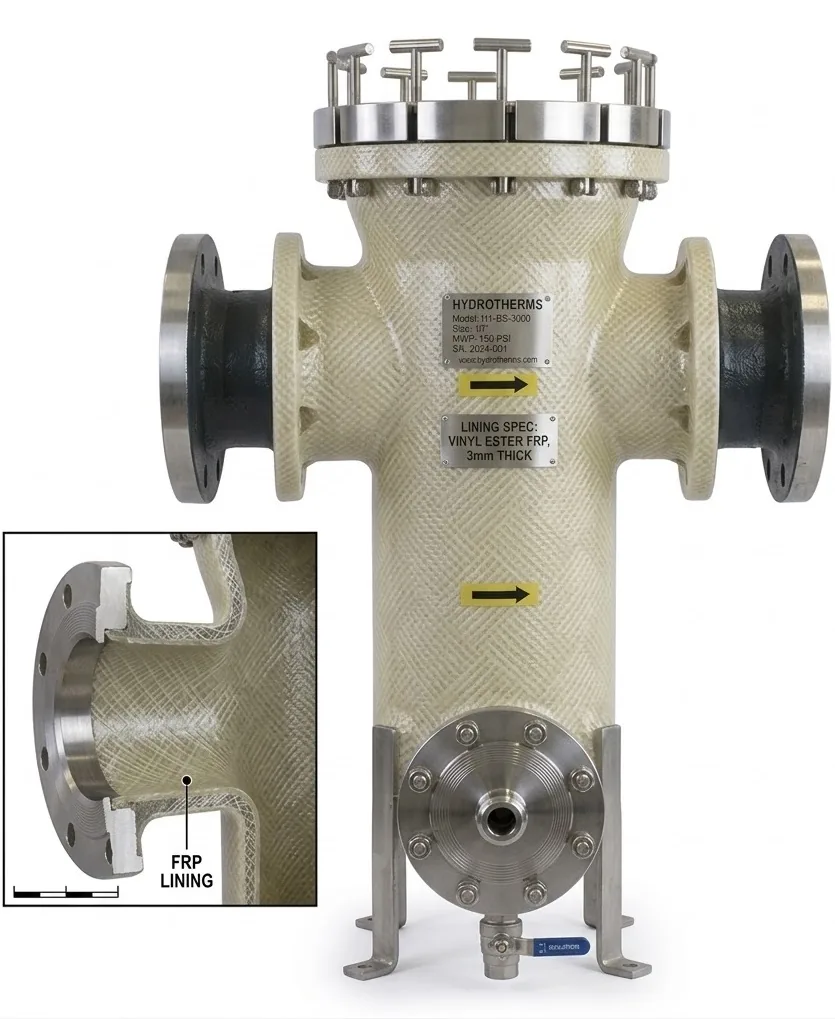
Six governing inputs, one evaluation, four engineered outputs. Here the fluid chemistry drives the entire selection, and the body configuration follows afterwards.
Screen and internals are assessed separately from the body — thin sections and large wetted area often make the screen the life-limiting component.
| Requirement | Possible Solution |
|---|---|
| Sour service, H₂S present | NACE MR0175 / ISO 15156 compliant construction |
| Chloride-bearing or seawater service | Duplex / super duplex, with zinc anodes where applicable |
| Strongly acidic or oxidising media | Nickel alloys — Hastelloy, Inconel, Alloy 20 |
| Aggressive fluid, moderate duty | Stainless steel body with upgraded screen and seals |
Material selection is application-specific and depends on fluid, concentration, temperature and contaminants. Upgrading only the screen and internals is often more economical than upgrading the entire body, and is a legitimate engineering choice.
Corrosive-service selection cannot be made from line size and flow alone — the fluid chemistry and temperature govern it.
Carbon steel and low-temperature carbon steel, alloy and chrome-moly grades, stainless steels 304, 316 and 316L, duplex and super duplex stainless steel, Monel, Inconel, Hastelloy B and C, titanium, nickel, aluminium bronze, and Alloy 20 in A351 CN7M and A990 CN3MCu. Viton, PTFE-encapsulated and EPDM seals, and special coatings or linings, are available where the service requires them.
In corrosive service the strainer is also a useful inspection point. Because the screen is removed periodically for cleaning, its condition gives early warning of attack on thin sections before the body is affected. Record screen condition at each cleaning, pay attention to crevice locations at gasket faces and screen seatings, and confirm that gasket and seal materials are compatible with the fluid as well as the temperature.
No, and often it should not be. The screen has thin sections and a large wetted area relative to its mass, so it is usually the life-limiting component. Upgrading the screen and internals while keeping a lower-cost body is a common and legitimate engineering choice.
Wherever hydrogen sulfide is present in the process fluid at levels defined by the standard. Compliance governs hardness limits, heat treatment and alloy composition across every pressure-wetted component, and addresses sulphide stress cracking, hydrogen induced cracking and SOHIC.
Standard austenitic grades such as 316 are susceptible to pitting and crevice corrosion in chloride-rich service. Duplex and super duplex grades are commonly specified instead, and zinc anodes are available for saltwater duties. Selection should be confirmed against the actual chloride content and temperature.
EN 10204 Type 3.1 as standard and Type 3.2 with independent third-party verification. NACE MR0175 / ISO 15156 compliance can be supplied combined with either. Ferroxyl testing for free iron contamination on stainless surfaces, and SSC and HIC testing, are available on request.
The fluid and its concentration, operating and design temperature, any chloride or H₂S content, and the applicable project specification. Material selection made without the fluid chemistry is guesswork.
Send the fluid and its concentration, operating and design temperature, any chloride or H₂S content, flow rate, line size and certification requirement — we will recommend materials for body, screen, seals and bolting.
Submit RequirementHave a difficult fluid? Send the composition and conditions and we will work through material options with you.
Talk to an Engineer